When Abha arrived in Auroville in 1978, she had just finished college in Delhi. She didn’t come with a plan of what she would do here. Just a firm conviction that this was where she wanted to be.
Two years later, in 1980, she and Radhika started something small, which, in her own words, was “almost like a schoolgirl hobby”.
“We both liked to make things with our hands,” she recalls. “We would go to Chennai with rucksacks, bring back printing ink, or other materials… whatever we needed—and we just started making things.
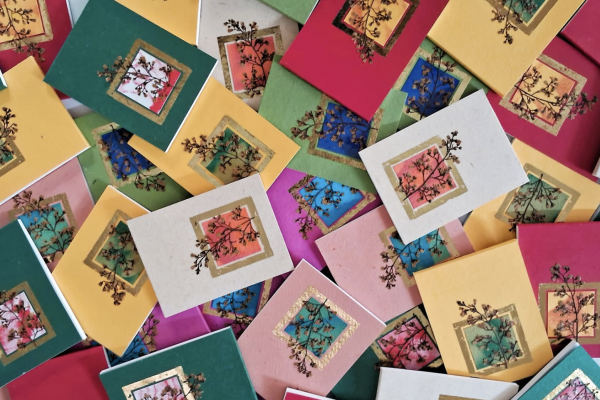
Shradhanjali has grown and developed for over four decades. Today it creates a wide range of products—greeting cards, stationery and various home products, all with pressed flower work, and the Beejika range made from seeds and seed pods
An Offering, Not Just a Business
The name itself holds its intention.
“Shraddha means faith, and Anjali means offering,” Abha explains. “It was our offering—of ourselves, of our work, of whatever skill we had—to Auroville.” At the time, Auroville was going through a period where self-sufficiency was essential. Shradhanjali became part of that collective effort—generating income while staying rooted in something deeper.
From the beginning, one idea shaped everything: beauty. Not beauty as decoration—but as something essential, something that could be received from nature and passed on.
“The flower we chose for our logo – Ipomoea – has been given the spiritual significance of “Nature makes an Offering of her Beauty” by The Mother, who founded Auroville.
“We wanted to capture the beauty of that offering of nature in what we created.”
Where Nature Becomes Craft
Shradhanjali’s work begins not in a workshop—but in a garden. Flowers are grown, individually picked, and then pressed. Seeds are gathered from the forest. Each piece—whether a card, a lampshade, or a piece of jewellery—emerges slowly, through a process that is entirely done by hand.
“We go the slow way,” Abha says. In a world where people look for immediate results, Shradhanjali works differently. Their work is intricate, patient, and deeply attentive.
She continues by saying “The time, the energy, the care you put into something… the product carries it.”
At the core, the intention is to capture and preserve the quiet intricacy of nature into something one can hold and keep.
Growing Alongside People
As Shradhanjali evolved, another pillar became equally important—people. What began with a few individuals gradually became a space where women from the surrounding villages could work, learn, and grow.
“Both their growth—and I use the word blossoming—is as important as anything else we do.”
Today, the team includes people who have been part of the journey for decades. Some joined as young women and have stayed for nearly 40 years. Over time, the transformation extends beyond the workspace. Abha reflects on how the region itself has changed—from a time when families hesitated to let their daughters travel through desolate red mud paths, to today, where the same women are not only independent but their own daughters have grown up to become nurses, medical assistants, software engineers and teachers.
“It’s a sea change,” she says. “And our girls are so proud.”
She says that undoubtedly opportunities for everyone have increased, but Auroville’s ideals have also played a significant role in this region.
Sustainability, Lived Quietly
At Shradhanjali, sustainability isn’t an added feature—it’s embedded into the way things are done.
Solar energy powers the workspace.
Wastewater is recycled and reused in the garden.
The building is designed to harvest rainwater
Organic manure supports the soil.
Materials are sourced locally, often from the surrounding areas or within Auroville itself.
But beyond systems, it is the pace and philosophy that define their approach. “I think our products are utterly different from industrial ones,” Abha reflects. “Everything is done by hand—from A to Z.” This way of working avoids shortcuts. It refuses to separate process from intention, and in doing so, it carries something that is difficult to quantify—but easy to feel.
Work as a Practice
For Abha, Shradhanjali is part of a larger inner journey. “There are challenges every day,” she says simply. “Something breaks, something goes wrong… that’s part of the process.” But these challenges are not seen as disruptions. They are part of what she describes as an ongoing practice—of learning, deepening, growing.
“To me, this is my yoga sadhana.” The work, the people, the process—are all part of something more than production and business.
Learning from a Different Model
When asked what conventional businesses could learn from Auroville, Abha doesn’t hesitate. “Honesty,” she says. “Be authentic. Don’t pretend.” In a landscape often driven by projected image, she points toward something more fundamental: alignment between intention and action.
“Money becomes a problem when it becomes the only goal or lens, everything else gets distorted or misused—people, products, nature.” Instead, she suggests a shift inward—toward reflection, responsibility, and a deeper understanding of what we are creating, and why.
Shradhanjali is not privately owned, it is a unit of Auroville. The management style prioritises perfection and quality, process and people, over profits, “It’s about not cutting corners. It’s about doing things as ethically and as beautifully as we can.” This allows for a different set of priorities. Fair wages are not compromised. Products are priced thoughtfully, balancing affordability with the true cost of handmade work.
Sharing the Experience
Shradhanjali also opens its doors to those who wish to experience this process firsthand.
Through guided visits, participants walk through the garden, learn about plants and their significance, and engage with the team. It is about slowing down, observing, and reconnecting—with nature, material, with process, and perhaps, with oneself.
More Than Craft
After more than 40 years, Shradhanjali still continues. Rooted in faith. Shaped by nature. Sustained by people.
And quietly, steadily, offering beauty.