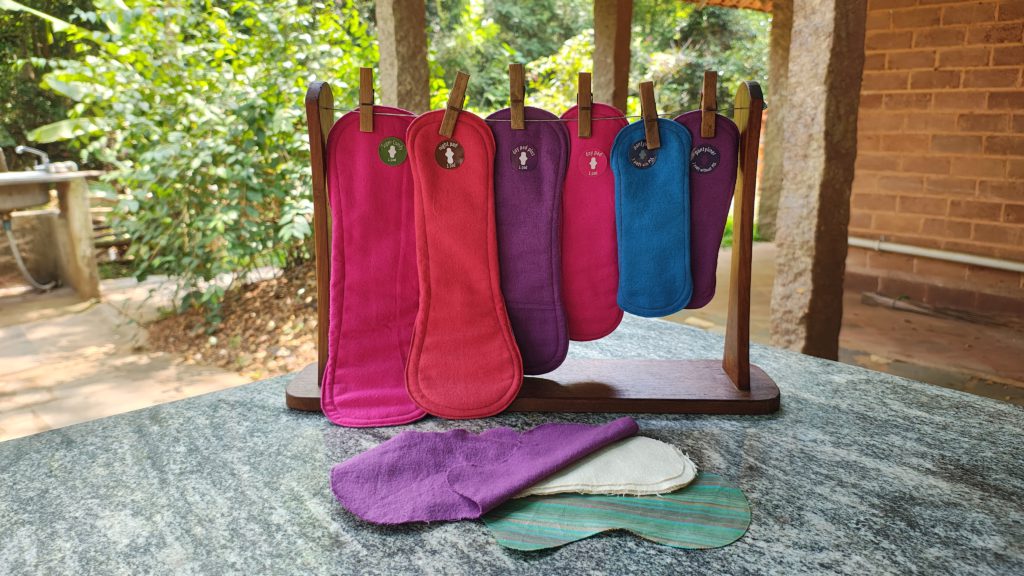
Menstruation is still a socially uncomfortable truth, hidden between myths and taboos and taken advantage of by marketing that sells polluting products as “convenience.” We already know that single-use sanitary pads and diapers end up in landfills, take hundreds of years to break down, and are now identifiable as microplastics in our water, soil, food, and the everyday products we all use—men, boys, women, girls, and children alike.
From one pad in a forest to a social enterprise
Eco Femme’s story began with Kathy, an Australian living a simple life in Auroville and doing reforestation work. One day she asked a practical question: where could she throw her used disposable sanitary pad? The answer was casual—“Just dig a hole and put it in the forest”—but it landed heavily. She suddenly realised that every pad she had ever thrown in a bin in Australia was also going somewhere, lasting for 500–800 years in landfills or soil.
That discomfort pushed her to experiment. She first stitched her own cloth pads, then made them for friends in Auroville. As more women asked for them, she noticed something else: in nearby villages, many women were still using cloth, which is good in principle, but surrounded by taboo, secrecy, and practical difficulties. She began to ask: how can we make something really uncomfortable, comfortable again? At that time, she was also working on income-generation for village women. The two ideas suddenly “clicked” together—the same women who were using cloth could stitch the pads, creating dignified work and a sustainable product for more women.
Today, Eco Femme is a women-led social enterprise with a small core team in Auroville and three village women’s groups stitching pads in bright, airy houses rather than factories under oppressive conditions. Eco Femme produces organic, reusable cloth pads and baby diapers, and anchors all this in menstrual health education.
What does “Eco Femme” mean?
Eco Femme’s name captures its vision in two words. “Eco” stands for ecology and economy: the health of the Earth, of our bodies, and of the livelihoods that sustain communities. “Femme” points to the feminine—women, girls, and the wisdom of bodies that bleed every month, often in silence. Together, Eco Femme is about centring women’s lives while caring for the wider web of life they are part of.
Celia, who has been with Eco Femme for over a decade, sees this every day. “What is really important in Eco Femme,” she says, “is that it’s good for the Earth, it’s good for your body, we do education, and we support livelihoods.” For her, the name is a constant reminder that menstrual health is not a niche issue; it is a doorway into conversations about sustainability, ecosystems, women’s health, and social justice.
Celia’s journey with Eco Femme
When Celia first arrived in Auroville from France, she imagined staying only five months. “I thought, ‘I’ll stay five months, then I’ll go back to France and find something else,’” she recalls with a laugh. She began in Eco Femme’s commercial team, then gradually moved into group visits, workshops, and training. More than eleven years later, she is still with Eco Femme, now focusing almost entirely on education.
What keeps her here is not only the mission, but the way the organisation lives its values internally. Eco Femme is founded by two women and staffed mostly by women. Weekly team meetings begin with check-ins—how each person is, what they are carrying that week—before moving into tasks and targets. For Celia, this “huge spirit of sisterhood” is part of why Eco Femme feels different from other NGOs she has known, and why she continues to pour her energy into its work.
The four pillars of Eco Femme
Over time, Eco Femme grew and established four interconnected pillars:
Sustainability
Pads and diapers designed to protect the Earth. Celia points out that most disposable pads and diapers are about 95% plastic, bleached with chlorine and filled with chemicals that are harmful for our health and can stay in the environment for generations to come. Eco Femme products use organic cotton with only a very thin leak-proof layer, aiming to minimise plastic.
Health
Many people think pads and diapers are convenient and harmless. Open discussions and workshops by Eco Femme reveal how common products made with plastic and chemicals can create dioxins and act as endocrine disruptors, affecting hormones and, for women, increasing cramps, PCOS, endometriosis, and even blood sugar balance. Eco Femme focuses on materials that are soft, breathable, and gentle on the body.
Education
Eco Femme welcomes open discussions and discovery sessions for all genders and ages. In parallel, they have an educational programme, often conducted as two 1.5-hour sessions in schools. They start with groups of girls and women, and recently they have added new approaches to create awareness amongst boys too. “The idea is to give them the power of informed choice,” Celia says. They lay out cloth, tampons, disposables, cups, reusable pads, and menstrual underwear, and ask: what is it made of, how do you use and wash it, what happens to it after use, who made it, who are you supporting when you buy it?
They also cover topics on menstrual health and hygiene.
Livelihoods
Women in villages stitch pads in good working conditions for a dignified income. Through the Pad for Pad programme, every pad purchased contributes towards pad kits and education sessions for girls in underprivileged schools. Celia calls this “eco-sisterhood”: “From one woman to another, we support each other, and we support the planet.”
Inside Eco Femme’s workshops
Eco Femme’s education work began with listening. When co-founder Jessamijn joined, she led research with a thousand women to understand local taboos, stories, and practical challenges around menstruation. On this foundation, the team built workshops that are as much about conversation as about information.
In schools, girls often arrive shy, reluctant to touch the “cute uterus” model, giggling and saying “ooh, disgusting.” By the end, many are laughing, asking questions, and, as Celia says, “really claiming their power to reconnect with themselves and their body.” In follow-up visits three months later, Eco Femme asks what they remember, what they liked or didn’t like about the pads, and how things have changed. This feedback loop is part of what Celia loves: “Everything is thorough in what we offer. It’s really based on the needs of the people and the women.”
The workshops are not only for girls. There are sessions for women, boys, and mixed groups. For boys, the focus is on understanding what the girls around them are experiencing and how products impact health and the environment. “If you are a father, a partner, a son, or a friend, you need to know about menstruation,” Celia insists. “You need to know what the women are dealing with, and what is the impact of those products on the environment and on you also.”
A women-led social enterprise, sustained by conversation
Eco Femme is structured as a social enterprise: profits from the sales fund the education programmes for girls, women, and boys. The impact is tangible: millions of disposable pads have been prevented from going to landfills, and more than a hundred thousand girls have been reached through school programmes and provided pad kits as part of the programmes. Yet Eco Femme’s team is clear that the work is far from finished. This is why they are expanding workshops, developing new offerings like full-day menstrual cycle retreats and online sessions for men and women—each one an invitation to keep the conversation going.
In the end, Eco Femme’s workshops are not just about sharing or teaching how to use a cloth pad. They are an entry point into bigger questions about women’s health, biology, chemicals and plastics, technology and “progress,” and what truly sustainable menstruation could look like. They are, as Celia puts it, “for everybody,” and invites everyone to come and take the conversation further.